The anticipated movement at each support point dictates the basic type of support required. Each type of support selected must be capable of accommodating movements obtained by one of the methods outlined later in this section. It is a good practice to select first the most simple or basic rigid support type and to add to the complexity only as conditions warrant. No advantage will be realized in upgrading a support when a simpler, more economical type can be shown to satisfy all the design requirements. Both vertical and horizontal movement must be evaluated.
Showing posts with label Plumbing. Show all posts
Showing posts with label Plumbing. Show all posts
Wednesday, January 1, 2014
Saturday, December 7, 2013
Types of Piping Joints
Joint design and selection can have a major impact on the initial installed cost, the long-range operating and maintenance cost, and the performance of the piping system. Factors that must be considered in the joint selection phase of the project design include material cost, installation labor cost, degree of leakage integrity required, periodic maintenance requirements, and specific performance requirements.
In addition, since codes do impose some limitations on joint applications, joint selection must meet the applicable code requirements. In the paragraphs that follow, the above-mentioned considerations will be briefly discussed for a number of common pipe joint configurations
Wednesday, December 4, 2013
Types of Flange Faces Commonly Used
There are five types of flange faces commonly found. The surface finish of the faces are specified in the flange standards.
Raised Face (RF)
The raised face is the most common facing employed with bronze, ductile iron, and steel flanges. The RF is ¹⁄₁₆-in high for Class 150 and Class 300 flanges and ¹⁄₄-in high for all pressure classes, higher than Class 300. The facing on a RF flange has a concentric or phonographic groove with a controlled surface finish. Sealing is achieved by compressing a flat, soft, or semimetallic gasket between mating flanges in contact with the raised face portion of the flange.
Thursday, November 28, 2013
Terminology Related To Valves
Actuator: A device that operates a valve by utilizing electricity, pneumatics, hydraulics, or a combination of one or more of these energies. Sometimes actuators are referred to as operators. In this chapter, the word operator will be used for a person who operates any equipment, machine, plant, or system.
Ambient conditions: The pressure and temperature of the environment surrounding a valve.
Back-flow: The flow that occurs in the opposite direction of the normal or expected fluid flow.
Back pressure: The static pressure existing at the outlet of a pressure-relief device due to pressure in the discharge system.
Tuesday, November 26, 2013
Actuators Selection and Application Guidelines
Actuators selection guidelines are provided to assist in selecting a suitable valve for any application. These guidelines are intended to cover all physical features and capabilities or limitations of different types of valves and which may be suitable for one particular application. The user must fully evaluate the pros and cons of using a particular type of valve and arrive at the most suitable selection, taking into consideration the life span expected and costs involved.
Sunday, November 24, 2013
Actuators Uses, Types and Failure Modes
A brief discussion is provided to assist the user in understanding the considerations affecting the selection of the type of actuators required for an application. Manually actuated valves do not change position due to a change in the mode of system operation or an accident. As such, a manually operated valve remains in the last position it was placed in. Manually operated valves are usually furnished with a hand wheel attached to the valve stem or yoke nut which is rotated clockwise or counter-clockwise to close or open a valve such as a gate or globe valve. Manually operated quarter-turn valves, such as a ball, plug, or butterfly valve, is provided with a lever to actuate the valve. There are applications in which the force required to actuate the valve is more than the force manually imparted through a hand-wheel or a lever. These applications include:
What are Safety Valves and Pressure Relief Devices
Safety valves and pressure-relief valves are automatic pressure-relieving devices used for overpressure protection of piping and equipment. Safety valves (Fig. A) are generally used in gas or vapor service because their opening and reseating characteristics are commensurate with the properties and potential hazards of compressible fluids. The valves protect the system by releasing excess pressure. Under normal pressure, the valve disc is held against the valve seat by a preloaded spring. As the system pressure increases, the force exerted by the fluid on the disc approaches the spring force. As the forces equalize, fluid begins to flow past the seat.
Monday, November 11, 2013
Butterfly Valves Types, Construction, Applications and Advantages
Butterfly valves are used to control and regulate or throttle the flow. They are characterized by fast operation and low-pressure drop. They require only a quarter turn from closed to full-open position. A typical flanged butterfly valve is illustrated in Fig. A. Butterfly valves are produced in sizes ranging from NPS 1¹⁄₂ (DN 40) to over NPS 200 (DN 5000). They are usually manufactured in flanged, wafer, and lug, or single-flange-type designs. The welding-end style is a specially engineered valve for a specific application. Threaded-end, grooved-end, and shouldered-end butterfly valves are also available to satisfy the joint type selected for the piping system. Butterfly valves are produced with metal-to-metal seats, soft seats, and with fully lined body and disc. The soft seats permit bubble-tight shutoff and the full lining enhances erosion and corrosion resistance.
Wednesday, October 30, 2013
Ball Valves Types, Construction, Applications and Advantages
The ball valve (Fig. 1) is a quarter-turn valve suitable for clean gas, compressed air, and liquid service. They also can be used for slurry service, but provisions for prevention of crud buildup must be made. The use of soft-seat materials such as nylon, delrin, synthetic rubbers, and fluorinated polymers imparts excellent sealing ability.
 |
| Fig. 1: Ball valve in closed position |
With fluorinated polymer seats, ball valves can be used for service temperatures ranging from 450 to 500 F ( 270 to 260 C); with graphite seats, service temperatures to 1000 F (538 C) or even higher are possible. Also, with metal backing seats, the valves can be used in fire-safe services. Ball valves are similar to plug valves in operation. They are nonbinding and provide leak-tight closure. The valves exhibit negligible resistance to flow because of their smooth body and port.
Sunday, October 6, 2013
PressFit Piping Systems Installation and Advantages
The Pressfit piping system is an innovative, rigid, self-restrained mechanical joining method for schedule 5 or lighter weight lightweight stainless steel and carbon steel pipe. This proprietary mechanical pipe joint is designed for use in small-bore piping systems, NPS ¹⁄₂ (DN15) to NPS 2 (DN50). The Pressfit system may be applied to any service that is compatible with the piping materials, the gasket material, and the temperature range of the system, unless prohibited by the manufacturer’s instructions.
Typical applications would include building-services piping, potable water, fire protection, heating and cooling, industrial processes, process cooling and heating systems, plant utilities, and vacuum systems.
Wednesday, October 2, 2013
PreStressed Concrete Cylinder Pipe (PCCP) Installation Procedure
Pipe Handling and Storage
A crane or backhoe outfitted with a steel cable sling may be used to unload pipe unless the pipe has a special exterior coating that could be damaged by a steel cable sling. In such cases, a fabric sling should be used. Multiple slings are often used in handling large pipe and fittings. Pipe can be stored directly on the ground in nonfreezing conditions. If freezing conditions are expected, the pipe should be set on wooden timbers off the ground to prevent the pipe from becoming frozen to the ground. Rubber gaskets should be stored in a cool place, out of the sun, away from fuel oil, gasoline, electric motors, and any other environment that can damage rubber.
PreStressed Concrete Cylinder Pipe (PCCP) Joints
Rubber O-ring Bell and Spigot Joint
+Lined+cylinder+pipe+(LCP)+and+(b)+embedded+cylinder+pipe+(ECP)+profiles.jpg "(a) Lined cylinder pipe (LCP) and (b) embedded cylinder pipe (ECP) profiles") |
| (a) Lined cylinder pipe (LCP) and (b) embedded cylinder pipe (ECP) profiles |
Figures A and B show a cross-section of the typical LCP and ECP bell and spigot joint. As can be seen, an O-ring rubber gasket is compressed into the spigot groove by the bell ring when assembled to form a water-tight seal. Portland cement grout is poured into a fabric band (diaper) by the installer to provide corrosion protection.
PreStressed Concrete Cylinder Pipe (PCCP) Manufacturing Process
The AWWA standard C3014 provides a comprehensive description of the manufacturing requirements for pipe and fittings. The purchaser should require, in the specifications, that all pipe and fittings be manufactured per the AWWA C301 standard.
Tuesday, October 1, 2013
Prestressed Concrete Cylinder Pipe (PCCP) Design
Design Parameters
PreStressed Concrete Cylinder Pipe (PCCP) is designed as a rigid structure to resist the simultaneous application of external loads and internal pressures. External dead loads normally encountered are earth loads, foundation loads, or surcharges applied at the ground surface. External live loads are caused by vehicular traffic, railroads, or construction equipment.
Prestressed Concrete Cylinder Pipe (PCCP) Types
Prestressed concrete cylinder pipe consists of a structural, high-strength concrete core, a steel cylinder with steel joint rings welded at each end providing water tightness, steel prestressing wire, and a portland cement-rich mortar coating. Two types of PCCP are manufactured: lined cylinder pipe (LCP), which is detailed in Fig. A and embedded cylinder pipe (ECP), which is detailed in Fig. B.
Tuesday, September 10, 2013
Function of Gaskets in Piping Design
The function of a gasket is to conform to the irregularities of the flange faces to affect a seal, preventing the inside fluid from leaking out. See following figure for a typical flange-gasket arrangement:
 |
| Function of Gaskets - Typical flange gasket arrangement |
The leak performance of the gasket is dependent on the stress on the gasket during operation. Each different type of gasket has its own inherent leak-tightness capabilities. The higher the gasket stress, the higher the leak-tightness capability.
Sunday, September 8, 2013
Flange Specification and Identification Codes
A flange is specified by the following information:
Type and Facing. The flange is specified according to whether it is, for example, ‘‘weld-neck RTJ’’ or ‘‘socket-weld RF.’’ Ring joint facing and RTJ gasket dimensions for ASME B16.5 are shown in Table A.1-6.
Wednesday, September 4, 2013
Types of Flange End Connection
The flange-end connection defines the way in which it is attached to the pipe. The following are commonly available standard flange end types:
Weld-Neck (WN) Flange
Weld-neck flanges are distinguished from other types by their long, tapered hub and gentle transition to the region where the WN flange is butt-welded to the pipe. The long, tapered hub provides an important reinforcement of the flange, increasing its strength and resistance to dishing. WN flanges are typically used on arduous duties involving high pressures or hazardous fluids.
Thursday, August 29, 2013
Speciality Tubular Products and its Types
There are many specialty tubular products designed for special applications requiring unique manufacturing methods for production. Examples are the rifled boiler tube, the finned heat-exchanger tube, the duplex tube, and the double-wall tube.
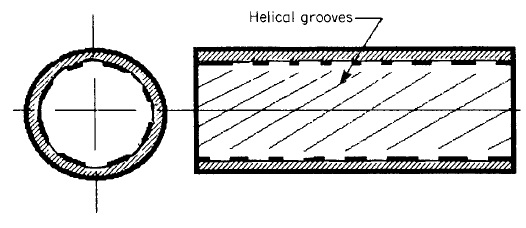 |
| Fig. 1 - Single rifled boiler tube |
The rifled boiler tube (Fig. 1) is used to provide an improved heat transfer surface on the inner surface of a boiler tube. The rifling twist, similar to that of a rifle, is produced by specially shaped mandrels over which the tube is drawn.
Monday, August 5, 2013
Olden Days of 3D Modeling in Petrochemical Industry
The olden days :)
This is what modeling looked like before computers. I wonder if anyone still does this. It looks like models of various plants.
So, before computer 3D modeling, there was this. And before models there was 'Plans/sections & details' drafted on a drafting board then they just built the plant.
This is what modeling looked like before computers. I wonder if anyone still does this. It looks like models of various plants.
So, before computer 3D modeling, there was this. And before models there was 'Plans/sections & details' drafted on a drafting board then they just built the plant.
Subscribe to:
Posts
(
Atom
)


